Paper-Based Box Inserts: How to Replace Foam Without Sacrificing Product Protection
Turn the guidance into a production brief
Send your product size, quantity, destination and target date for a structured packaging recommendation and quote.
Paper-Based Box Inserts: How to Replace Foam Without Sacrificing Product Protection
Replacing foam inside a custom paper box sounds simple until the first prototype arrives. A folded paper cradle may look elegant but release a heavy bottle during a drop. Molded pulp may protect well but mark a polished surface. Honeycomb paper may absorb impact but occupy more space than expected. A buyer who selects an insert only because it is “paper” can trade one material problem for damage, slow packing, excess freight, or a disappointing presentation.
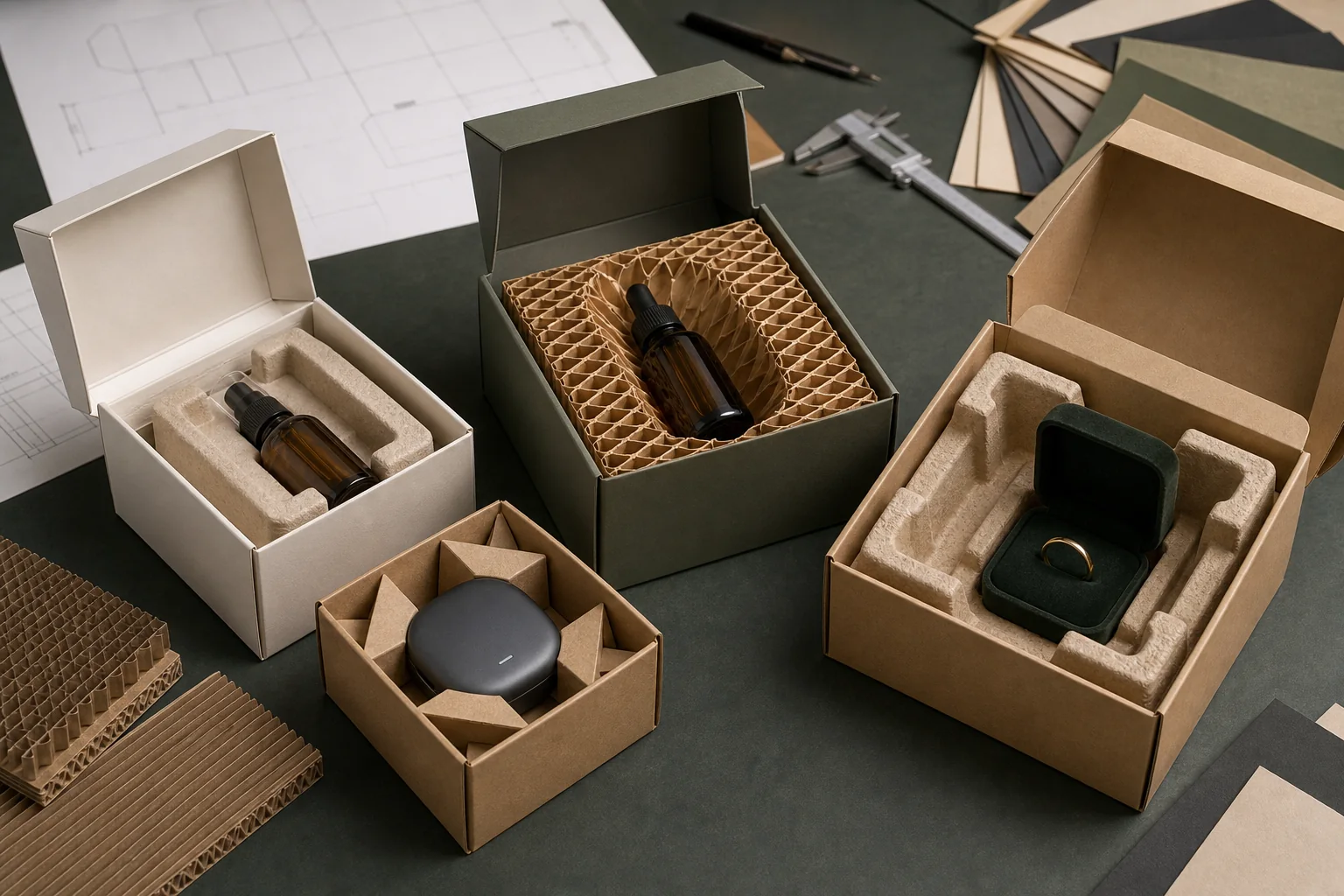
The practical answer is to choose an insert by function before choosing it by appearance. Define the product’s weight, fragility, surface sensitivity, center of gravity, dimensional tolerance, removal method, sales channel, and delivery hazards. Then compare folded paperboard, corrugated structures, molded fiber, honeycomb paper, and hybrid paper systems against those needs. A successful foam-free insert is not a decorative tray. It is a controlled suspension and presentation system.
This guide explains how to engineer paper-based inserts for cosmetics, glass bottles, electronics, jewelry, candles, apparel accessories, and premium gift sets. It also covers the questions buyers frequently raise in packaging communities: which paper alternative behaves most like foam, how much tooling is required, whether molded pulp survives humidity, how to stop products moving, and when a small quantity makes a fully custom insert uneconomical.
Why Brands Are Reconsidering Foam Inserts
Foam became common because it is easy to cut, compressible, light, and available in many densities. It can hold irregular shapes with tight tolerances and cushion fragile products. Those advantages are real. The difficulty is that foam can complicate material separation, create an inconsistent disposal experience, carry odor, collect dust, discolor, or conflict with a brand’s paper-focused packaging claim. Some markets and retailers also prefer simpler material combinations.
Paper alternatives can make the pack easier to understand. A customer sees a paper box and a paper insert, separates any unavoidable non-paper accessory, and follows a familiar recycling route where local infrastructure accepts the grade. Paper structures also offer natural texture, strong print compatibility, flat-shipping options, and an opportunity to make protection visible rather than hiding it beneath fabric or foam.
However, “paper-based” does not automatically mean lower impact or better performance. A thick insert that causes a larger outer carton may consume more material and freight space. A molded fiber tray shipped across long distances can carry unnecessary volume. A laminated structure may be difficult to separate. Damaged products have their own environmental and commercial cost. The correct comparison includes material mass, production yield, transport density, packing labor, product damage, customer instructions, and realistic local recovery.
Start With the Protection Job
Before asking a converter for an insert, write a protection brief. Record the product’s maximum and minimum dimensions, mass, center of gravity, breakable areas, cosmetic surfaces, closures, projections, and accessories. State whether the package travels through parcel delivery, pallet distribution, retail replenishment, or hand delivery. A lightweight lipstick set faces different forces from a tall glass fragrance bottle, even when both occupy similar space.
Define the permitted movement. Some soft products can move a few millimeters without harm. A decorated bottle may scuff if it rotates. A jewelry piece may tangle if its chain is not controlled. An electronic device may need connectors isolated and buttons protected from constant pressure. The insert must restrain the product in the directions that matter while avoiding concentrated loads on weak points.
Write down the opening experience too. Should the customer lift the product vertically, pull a ribbon, press a finger notch, slide a tray, or remove a top pad first? An insert that protects perfectly but traps the product is not successful. Removal force, hand size, accessibility, and the likelihood of a customer replacing the item all influence geometry.
The Five Main Paper-Based Insert Families
1. Folded Paperboard Cradles
Folded paperboard inserts are die-cut sheets that form platforms, wells, tabs, bridges, locking walls, or suspended decks. They can ship flat and often use the same printing and cutting supply chain as folding cartons. Their clean surface supports premium presentation, instructions, color, and brand graphics without adding a separate label.
This format works well for lighter cosmetics, small accessories, stationery, confectionery with appropriate barriers, and products with regular geometry. Strategic folds create stiffness without excessive material. A raised deck can hide accessories below the hero product. Reverse folds and locking tabs can create retention without glue, helping packers separate and assemble components.
The tradeoff is assembly. Each extra fold increases packing time and introduces another opportunity for error. Narrow tabs may tear, paper bridges may buckle under concentrated weight, and repeated removal can weaken scores. The designer should minimize steps, use unmistakable fold directions, and test assembly with the people who will pack production units.
2. Corrugated Paper Inserts
Corrugated inserts use fluted paper between liners to provide thickness, edge strength, and energy absorption. They may be simple pads, folded partitions, roll-ups, corner blocks, or die-cut retention frames. E-flute and other microflutes can create relatively refined structures, while larger flutes provide more cushioning and stacking support at the cost of space and visible thickness.
Corrugated structures are useful for heavier bottles, hardware, candles, electronics, sample kits, and ecommerce packs. A pair of end caps can suspend a product away from outer walls. Cross partitions keep several containers from contacting each other. Rolled or layered sections concentrate strength where loads enter the pack.
Flute direction matters. Compression strength is greatest in a designed orientation, and a poorly positioned score can crush flutes or create an inaccurate fold. Exposed cut edges may shed fibers near polished products. The engineering drawing should specify flute, board combination, grain and flute direction, cut quality, and any liner color required for presentation.
3. Molded Fiber Trays
Molded fiber, often called molded pulp, forms three-dimensional cavities from a fiber slurry. It is the closest paper-based option to a shaped tray because it supports complex contours, ribs, draft angles, bosses, and integrated finger access. It can protect bottles, electronics, homeware, personal care products, and multi-component kits while presenting a unified natural surface.
Different molding processes produce different appearances and tolerances. Traditional wet-pressed pulp may have a rougher surface and broader dimensional variation. More refined processes can create smoother faces, sharper detail, thinner walls, and better color control, but tooling and unit cost may rise. Ask the supplier to name the process, fiber source, surface specification, moisture target, and dimensional tolerances rather than approving the generic word “pulp.”
Molded fiber requires draft so parts can release from tools. Vertical walls, undercuts, and extremely sharp internal corners are limited. Deep pockets may need relief holes or redesigned ribs. The tray should use geometry to resist bending: perimeter walls, arches, radiused transitions, and rib networks are usually more effective than simply adding uniform thickness.
4. Honeycomb Paper and Expanded Paper Structures
Honeycomb paper uses a cell structure to create stiffness and crush resistance with relatively little material. It can form pads, frames, blocks, or cradles for heavy products. Expanded paper and slit paper wraps create flexible three-dimensional networks that conform around irregular items and replace loose plastic cushioning in some applications.
These materials are effective when the main job is energy management or void control. Honeycomb pads can isolate a heavy object from the box wall. Expanded paper can wrap ceramics, bottles, and samples. The visual language is functional and visibly paper-based, which can suit natural, industrial, or craft-oriented brands.
The limitations are finish, volume, and repeatability. Honeycomb cut edges can look technical rather than refined. Flexible wraps depend on packer technique and may produce different results between units. Cell structures also compress permanently after a major impact. If consistent premium presentation matters, combine protective honeycomb below a cleaner paperboard deck instead of asking one material to perform every role.
5. Hybrid All-Paper Systems
Hybrid systems combine two or more paper structures. A molded fiber base may support the product while a printed paperboard collar improves presentation. Corrugated end caps may carry load beneath a smooth folding carton platform. Honeycomb blocks may sit inside a rigid box shoulder while a die-cut top card controls the reveal.
This approach often produces the best balance because protection, assembly, and appearance are different jobs. The components should remain easy to separate and identify. Avoid unnecessary adhesive, plastic film, or permanent lamination between grades unless testing shows it is essential. Number components on packing instructions and design them so an operator cannot install them backward.
Material Selection Beyond the Label
Paperboard specifications should include caliper or basis weight, grade, surface, recycled content when required, grain direction, moisture condition, and expected fold endurance. A high basis weight does not guarantee high stiffness because fiber composition and caliper differ. Request representative samples from the intended mill or an agreed equivalent rather than comparing numbers alone.
Corrugated specifications should identify flute profile, liners, medium, board grade, and strength criteria. A compact microflute may look premium but provide less travel during impact. A larger flute may cushion better but force a larger box. The correct choice is a package-system decision, not a preference made from a material swatch.
For molded fiber, record fiber recipe, forming method, wall thickness range, density, surface side, color range, moisture content, odor requirement, and acceptable fiber marks. Recycled fiber can offer a desirable natural appearance but may vary between lots. Virgin or selected fibers can improve cleanliness and consistency where products have sensitive surfaces or strict presentation requirements.
Fit, Clearance, and Tolerance Stacking
Paper inserts are often less forgiving than soft foam. Product dimensions vary, paperboard thickness varies, scores shift, molded fiber shrinks, and operators place parts differently. If the nominal cavity exactly matches the nominal product, some production units will bind while others will be loose.
Build a tolerance stack using product maximum and minimum dimensions, insert manufacturing limits, box variation, and assembly placement. Decide where clearance is necessary and where controlled contact is useful. A bottle may be held at its stronger shoulder and base while its printed sidewall remains untouched. A device may rest on broad supports while buttons and ports sit inside relief areas.
Use radiused contact surfaces instead of sharp paper edges against decorated products. Add small lead-in angles that guide a product into position. When friction retains an item, measure insertion and removal force across multiple samples and environmental conditions. Paper becomes softer at high humidity and can become more brittle in dry conditions.
Engineering for Heavy Glass Bottles and Jars
Heavy glass creates concentrated loads. A thin paperboard platform may look stable on a table but collapse after vibration or a corner drop. Support the product near strong geometric regions, spread load through ribs or folded beams, and keep glass away from the outer package walls. A bottom pad alone rarely prevents lateral movement.
For tall bottles, control the neck or shoulder as well as the base, but never transmit excessive force through a pump, cap, or decorative collar. Two-level retention can reduce tipping. If several bottles share a box, partitions must prevent glass-to-glass contact under vibration and after modest permanent deformation.
Test leakage scenarios. A paper insert exposed to oil, fragrance, or skincare formula may stain, lose strength, or transfer residue through the package. The primary container and closure should prevent leakage, but the packaging team should define what happens when a small leak occurs and whether a barrier, removable bag, or different insert surface is justified.
Protecting Scratch-Sensitive Surfaces
Uncoated paper, recycled fibers, and rough molded pulp can abrade gloss coatings, soft metal, lacquer, or polished glass. Conduct rub tests with the real product finish. Place the product in the insert, apply representative vibration, and inspect under strong angled light. Damage that is invisible in normal room light may become obvious on a retail counter.
Protection can come from geometry rather than adding fabric. Hold the product only at hidden or durable zones. Increase clearance around visible faces. Use a smoother formed-fiber process, a clean paper liner, tissue wrap, or removable protective sleeve when needed. Any liner adhesive must remain stable through temperature and humidity without lifting at edges.
Dust and loose fibers also matter. Set cleanliness standards, especially for cosmetics, electronics, optical products, and dark glossy surfaces. Ask how inserts are cut, extracted from tools, dried, stored, and packed. A clean master carton and protective bag around insert stacks can prevent warehouse dust from becoming part of the unboxing experience.
Moisture, Humidity, and Climate Risk
Paper absorbs and releases moisture. Molded fiber may soften, paperboard can curl, corrugated compression strength can decline, and tight cavities can change dimension. This does not make paper unsuitable; it means environmental conditions belong in the specification and test plan.
Identify the climate route from converting plant to warehouse to customer. Ocean freight, tropical storage, cold delivery, and air-conditioned retail can create repeated changes. Condition prototypes at relevant temperature and relative humidity before checking fit, compression, odor, and appearance. Do not approve only samples that have spent days in a comfortable design office.
Design with drainage and drying in mind for molded fiber. Thick isolated masses dry slowly and can retain moisture or odor. Balanced wall sections, ribs, and ventilation openings help production consistency. Suppliers should control drying, moisture measurement, storage, and packaging before shipment.
Dielines, Tooling, and Prototype Strategy
Folded and corrugated inserts begin with a dieline, but the drawing should follow the protection brief. Community discussions often treat dielines as artwork templates; in reality, structure comes first. The converter needs board attributes, fold allowances, score behavior, inside loss, outside gain, glue or lock details, and production tolerances.
Start with inexpensive white samples or plotter-cut prototypes. Test several geometries with real products before paying for production tooling. A plotter sample may not perfectly represent die-cut edges or production crease quality, so record what it controls. For molded fiber, early prototypes may be machined, formed from temporary tools, or produced by another method. Their stiffness and surface can differ from final production.
Approve tooling drawings and cavity orientation before tooling begins. Confirm whether one tool produces several components, how parts nest for freight, expected tool life, ownership, storage fees, and modification limits. A small dimensional change may be inexpensive in folded board but require a tool change for molded fiber.
Packing-Line Efficiency
A foam replacement should not create an invisible labor problem. Count the insert components and assembly motions. Time trained and untrained operators. Watch for tabs that fail to lock, folds that spring open, parts that look symmetric but have only one correct orientation, and products that require force to seat.
Use poka-yoke principles: geometry should prevent incorrect assembly. Different tabs can use visibly different shapes. A corner notch can indicate orientation. Components can arrive pre-assembled when labor savings justify the added freight volume. Packing instructions should show each step with the approved product and packaging revision.
Run a pilot pack before mass production. Measure units per hour, damaged packaging, product scratches, rework, and operator feedback. A structure that saves a few cents in material but adds twenty seconds of labor may increase total cost. The best insert is protective, attractive, and uneventful to pack.
Transit Testing the Complete Package
Never test the insert by itself. Test the product, insert, sales box, outer shipper, void fill, seals, and master-carton arrangement as a complete system. The decorative box may not be designed to absorb parcel impacts, and a strong insert cannot compensate for an oversized shipping carton that allows repeated movement.
Choose a protocol appropriate to product value and distribution. Typical evaluations include drops on faces, edges, and corners; random vibration; compression or stacking; and climate conditioning. Inspect both function and cosmetics afterward. A product that still works but arrives scratched, off-center, dusty, or difficult to remove has not passed a premium presentation requirement.
Test more than one unit. Paper materials and products vary, and a single successful sample cannot reveal the distribution. Use production-representative materials whenever possible. Document configuration, sample identity, conditioning, sequence, damage, and corrective action. Retain tested and approved control samples.
Comparing Cost Correctly
Unit insert price is only one line. Include tooling, sampling, assembly, storage, inbound freight, outer-box size, product damage, inspection, disposal instructions, and obsolete inventory. A flat paperboard insert may have a low delivered cost but a higher assembly cost. Molded fiber may reduce labor yet require tooling and more storage volume.
For small quantities, semi-custom solutions may be wiser. Use a stock box with a standardized paper insert, adjustable corrugated partitions, die-cut pads, tissue, or a printed sleeve. This preserves cash and allows product revisions. Move to dedicated tooling after product dimensions and reorder velocity become stable.
Ask suppliers for price breaks and the assumptions behind each. A low quote may use a different board, broad tolerance, manual trimming, or untested packing method. Compare delivered cost at the same specification and destination. Record whether tooling, packaging of empty inserts, and quality inspection are included.
Claims, Disposal Instructions, and Material Verification
Use precise customer language. “Paper-based” describes material family but does not guarantee acceptance in every local program. Coatings, adhesives, contamination, dark colors, and mixed components influence recovery. Ask suppliers for material declarations and chain-of-custody documentation when a certified fiber claim is part of the brief.
Design disposal instructions around the actual assembly. If the customer must remove a ribbon, magnet, liner, or product bag, make the step clear and physically easy. Avoid claims that cannot be supported across target markets. The most credible message is usually specific: name the components, explain separation, and direct customers to local rules.
Material reduction should be measured together with damage performance. A lighter insert is not an improvement if breakage rises. Record material mass, pack volume, product survival, and packing time before and after the change. This creates a defensible comparison and helps the next design iteration.
Supplier Questions for Paper Insert Projects
Ask which insert families the supplier engineers in-house; which operations are subcontracted; what product data they require; how tolerances are calculated; how board, flute, fiber, moisture, and cleanliness are controlled; which prototype methods are available; and what differences exist between prototype and production.
Also ask how the supplier tests compression, insertion force, removal force, vibration, drops, abrasion, and climate exposure. Request examples similar in weight, fragility, surface, and distribution channel rather than examples that merely look attractive. Confirm how defects are classified and how first-off production pieces are approved.
Strong suppliers will challenge an unsuitable material choice. They may recommend corrugated end caps instead of a thin folded tray, a smooth collar over molded fiber, or a slightly larger box to gain a safe deceleration distance. A useful technical objection is evidence of process knowledge, not resistance to the brief.
A Foam-Free Insert Decision Matrix
| Requirement | Strong starting option | Watch closely |
|---|---|---|
| Lightweight retail product | Folded paperboard cradle | Assembly time and tab strength |
| Heavy bottle or device | Corrugated end caps or molded fiber | Concentrated load and clearance |
| Complex three-dimensional shape | Molded fiber tray | Draft, tooling, shrinkage, surface |
| High-impact cushioning | Honeycomb or engineered corrugated | Pack volume and permanent crush |
| Premium printed presentation | Paperboard deck or collar | Scuffing and score cracking |
| Very small launch quantity | Stock insert, partitions, or pads | Manual packing consistency |
| Multi-item gift set | Hybrid paper system | Component count and orientation |
| Sensitive glossy surface | Non-contact geometry plus smooth liner | Dust, abrasion, adhesive edges |
This matrix is a starting point, not a final specification. Product testing may lead to a hybrid. Keep the number of materials and components as low as practical, but do not force one material to perform incompatible roles.
The Approval Checklist
Before authorizing production, confirm the product revision and tolerance range; insert material and process; dimensions and measurement points; contact zones; insertion and removal force; assembled orientation; packing steps; visual standard; cleanliness; moisture and odor limits; box and shipper compatibility; transit-test results; component separation; tooling ownership; and signed control samples.
Check that artwork, disposal instructions, and material claims match the physical structure. Confirm how inserts are bundled and protected during delivery. Approve master-carton quantity and stacking limits. Record every prototype difference that will change in production.
Finally, repeat critical requirements on the purchase order. “Same as sample” is insufficient when the sample used temporary tooling, substitute board, hand assembly, or a different surface. A controlled specification turns a promising prototype into a repeatable packaging system.
Conclusion
Replacing foam is not a one-for-one material swap. It is an opportunity to redesign how the product is supported, presented, packed, shipped, and separated after use. Folded paperboard, corrugated structures, molded fiber, honeycomb, and hybrid systems each solve different problems. Selection should follow the protection job, product tolerance, delivery route, and customer interaction.
The most reliable path is evidence-based: define the hazards, prototype several structures, test with real products, measure packing labor, condition samples for climate, run distribution tests, and retain an approved standard. When those steps are followed, a paper-based insert can deliver precise presentation and robust protection without depending on conventional foam.
Frequently Asked Questions
Which paper-based insert is the closest replacement for custom-cut foam?
Molded fiber is often the closest shaped alternative because it can form cavities, ribs, and product-specific supports. It is not automatically interchangeable with foam, so draft angles, surface abrasion, dimensional variation, humidity, and impact performance must be tested with the real product.
Can folded paperboard inserts safely hold heavy glass bottles?
Yes, when the structure uses folded beams, broad load paths, two-level retention, and suitable board. A simple flat platform is rarely enough. Heavy bottles should be tested for base loading, tipping, lateral movement, vibration, drops, and clearance from the outer box walls.
Does molded pulp become weak in humid shipping conditions?
Its stiffness can decline as moisture rises. The risk can be controlled through fiber selection, density, geometry, balanced wall thickness, drying control, moisture limits, protective shipping configuration, and climate-conditioned testing before approval.
What is the best foam-free option for a small production run?
A stock box with adjustable corrugated partitions, die-cut pads, folded paperboard, tissue, or a semi-custom insert often carries less risk than dedicated molded tooling. Move to a fully custom insert after dimensions and reorder demand become stable.
How should a brand verify that a paper insert provides enough protection?
Test the complete packed system using production-representative products and materials. Include climate conditioning, vibration, compression where relevant, and drops on faces, edges, and corners. Inspect product function, cosmetic surfaces, insert movement, presentation, and removal after testing.