The Structural Integrity Handbook: Engineering Custom Rigid Boxes for Global High-Value Distribution
Turn the guidance into a production brief
Send your product size, quantity, destination and target date for a structured packaging recommendation and quote.
The Structural Integrity Handbook: Engineering Custom Rigid Boxes for Global High-Value Distribution
The transition from a mere container to a world-class brand ambassador is not achieved through aesthetic design alone. In the contemporary B2B procurement environment, the physical durability and mechanical reliability of a Custom Premium Packaging solution are the true benchmarks of quality. As global supply chains become increasingly complex and regulatory frameworks more stringent, the burden on packaging engineers to deliver zero-defect performance has reached an all-time high.
This handbook is designed for brand owners, packaging engineers, and supply chain directors who require a deep technical understanding of the materials and processes that define structural integrity in luxury packaging. We examine the physics of substrate density, the precision of computerized V-grooving, the chemistry of climate-resistant adhesives, and the auditory engineering of magnetic closures. By the end of this guide, you will understand why luxury is built from the rigid core upward.
Chapter 1: The Physics of the Foundation — Substrate Density and the Modulus of Elasticity
The structural soul of every luxury box resides in its core material, typically a high-density greyboard. While the industry standard often hovers around 1200gsm, this density frequently fails when subjected to the vertical compression and lateral pressures of international ocean freight. The modulus of elasticity—a material's resistance to being deformed elastically when a force is applied to it—is significantly higher in 1800gsm and 2400gsm Grade AAA greyboard.
For brands shipping high-value items such as Jewelry Showcase Boxes or Custom Luxury Gift Boxes, the foundation must be unshakeable. A denser board does not just provide a better 'hand feel'; it provides the structural stability needed to prevent warping. Warping is a thermodynamic process where moisture enters the cellulose fibers of the paper, causing them to expand and create internal tension. By utilizing a tighter fiber matrix in our high-gsm boards, we reduce the available void space for moisture absorption, effectively neutralizing the risk of deformation in humid shipping routes.
Furthermore, the density of the board influences the acoustic properties of the unboxing ritual. A high-density board absorbs vibration more effectively than its lower-density counterparts, leading to a damped, solid sound when the lid meets the base. This acoustic profile is a critical, though often overlooked, indicator of brand prestige.
Chapter 2: Geometric Perfection — The Mechanics of Computerized V-Grooving and 90-Degree Tolerances
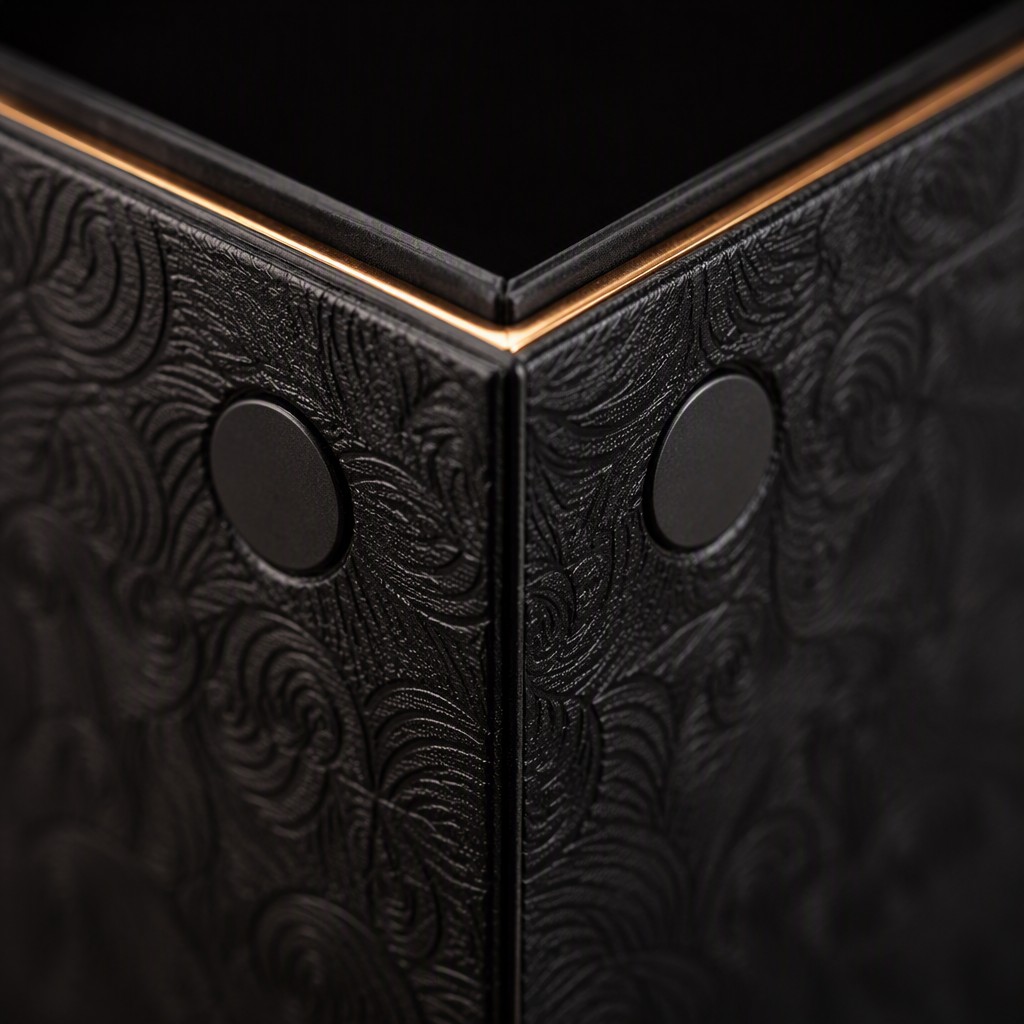
In the engineering of Custom Sliding Drawer Boxes and Collapsible Magnetic Gift Boxes, the sharpness of the fold is the definitive marker of technical craftsmanship. Traditional die-cutting utilizes a creasing rule that pushes the board material aside, creating a rounded corner that often appears 'soft' or 'puffy.' In contrast, computerized V-grooving involves the mechanical removal of a precise V-shaped wedge of material from the board core.
This process requires diamond-tipped industrial blades capable of removing material to a depth that leaves only a 0.1mm layer of fiber remaining. The result is a fold that is architecturally sharp—a perfect 90-degree corner that captures the light with surgical precision. However, this precision brings its own set of engineering challenges. If the V-groove is too deep, the fiber layer will crack during folding; if it is too shallow, the corner will lack sharpness and structural integrity.
We maintain a technical tolerance of +/- 0.05mm across all our V-grooving lines. This micro-level control ensures that when the box walls are erected, they meet with absolute flushness. For B2B buyers, this translates into a higher stacking strength on the retail shelf and a zero-gap finish that justifies a premium market position.
Chapter 3: Atmospheric Resilience —The Chemistry of Moisture-Resistant Adhesion
The most frequent point of failure in luxury packaging is not the board or the paper, but the adhesive layer between them. Many manufacturers utilize standard water-based glues that are susceptible to hydrolysis in high-humidity environments. This leads to 'delamination,' where the decorative wrap paper begins to peel away from the rigid greyboard core, or the formation of unsightly air bubbles.
To combat this, LuxePack Pro utilizes advanced moisture-resistant vegetable-based adhesives. These glues are engineered with a high solids content and specific tackifiers that maintain bond strength across a temperature range of -20°C to +60°C. This ensures that whether your Custom Premium Packaging is stored in a sub-zero air freight hold or a sun-baked shipping container in a tropical port, the bond remains intact.
Additionally, the adhesive application process itself must be meticulously controlled. We utilize automated roller-coating systems that apply a uniform micron-thin layer of glue across the entire surface of the wrap. This prevents 'glue-soak,' where excess moisture from the adhesive weakens the paper fibers and leads to surface wrinkling. By managing the chemistry and application of our adhesives, we guarantee a finish that remains pristine through the entire global distribution cycle.
Chapter 4: The Physics of Closure —Calibrating N52 Neodymium Magnetic Systems
The magnetic closure is perhaps the most critical mechanical component of a Custom Magnetic Rigid Gift Box. It is the mechanism that facilitates the final moment of unboxing, yet it is often the most poorly engineered. A closure that is too weak will pop open during transit, damaging the contents; a closure that is too strong will frustrate the consumer and potentially tear the lining paper.
Engineering the perfect 'snap' involves a complex calculation of magnetic flux density (measured in Gauss) versus the mechanical torque required to pivot the lid. We exclusively utilize N52 Neodymium magnets—the strongest permanent magnets available commercially. Because N52 magnets offer superior performance in a smaller footprint, we can hide them deeper within the board core, ensuring they are completely invisible to the consumer while maintaining a high pull force.
In our laboratory, we use digital force gauges to verify the break-away force of every magnetic lid prototype. We target a specific range that allows for a 65-decibel auditory click—the signature sound of security. Furthermore, we account for 'air-cushion' resistance—the compression of air inside the box as the lid closes—by engineering tiny, invisible micro-vents in the structural base. This ensures that the lid closes smoothly and consistently every single time.
Chapter 5: Sustainable Load-Bearing —The Rise of Multi-Layered Paper Pulp Inserts
As the global push for plastic elimination intensifies, the greatest engineering challenge in luxury packaging is the replacement of EVA foam and plastic vacuum trays. Luxury products—from heavy glass serum bottles to weighted jewelry sets—require a level of shock absorption and structural support that standard paper folds often cannot provide.
The solution lies in the engineering of multi-layered rigid pulp structures. By utilizing high-density dry-molded fiber technology, we can create inserts that possess the same structural rigidity as wood or plastic while remaining 100% recyclable. These inserts are designed with geometric ribbing patterns—much like an airplane wing—to provide maximum strength-to-weight ratios.
For our Jewelry Boxes, we have pioneered the use of FSC-certified pH-neutral paper liners. Many sustainable materials are acidic, which can cause oxidation and tarnish on precious metal surfaces over time. Our engineered liners are chemically stabilized to protect the product while providing a tactile experience that matches the brand's prestige. This is the future of luxury: uncompromising performance without environmental compromise.
Chapter 6: Global Validation —Implementing ISTA-3A Testing Protocols
A rigid box is only as good as its performance in a drop test. At LuxePack Pro, we do not guess; we validate. Every new structural design is subjected to ISTA-3A testing—the international standard for parcel delivery systems. This involves a series of 17 different drops from varying heights, as well as atmospheric conditioning and random vibration cycles.
By analyzing how a Custom Logo Gift Box fails under these extreme conditions, we can identify weak points in the corner joints or the insert geometry before mass production begins. This data-driven approach allows us to optimize the material usage—using a thinner board where the structure is inherently strong and reinforcing areas of high stress. The result is a packaging program that is leaner, more cost-effective, and guaranteed to deliver a flawless unboxing experience to the end consumer.
Chapter 7: The Physics of Fiber Orientation
Beyond density, the orientation of the cellulose fibers in the rigid board plays a critical role in resisting warping. Paper fibers expand and contract primarily in their cross-direction. In high-value Luxury Paper Gift Bags and rigid boxes, we engineer the grain direction to oppose the natural tension points of the box's geometry. This technical nuance ensures that even under the stress of 90% relative humidity, the box walls remain perfectly vertical. It is this level of microscopic engineering that distinguishes a prestige container from a commodity package.
Chapter 8: Conclusion —Packaging as a Strategic Asset
In the 2026 economy, packaging is no longer a line-item cost; it is a strategic driver of customer lifetime value. By investing in structural engineering and mechanical precision, brands can ensure their high-value products are delivered in a container that commands respect and justifies premium price points. World-class luxury is built from the greyboard core upward. For organizations seeking to dominate their industry through superior product presentation, understanding the physics of the box is the first step toward excellence.
FAQ: B2B Structural Engineering Questions
Why is Grade AAA 1800gsm greyboard recommended over standard 1200gsm for global shipping?
1800gsm provides a higher modulus of elasticity and superior warping resistance, ensuring that the box walls maintain their geometric integrity when exposed to fluctuating humidity in international shipping containers.
What is the benefit of N52 magnets for high-end magnetic gift boxes?
N52 Neodymium magnets offer the highest magnetic flux available in small dimensions. This allows for a hidden, seamless closure that can overcome the torque of heavy lids while providing a consistent, premium auditory 'snap' signal.
How do you prevent luxury boxes from warping in humid climates?
We use moisture-resistant adhesives and engineer the fiber orientation of the rigid core. Additionally, our Grade AAA board is dried in a climate-controlled facility to stabilize internal moisture before lamination.
Can sustainable paper-based inserts support heavy products like glass bottles?
Yes. Through structural ribbing and multi-layer lamination of high-density pulp, we can create eco-friendly inserts that match the weight-bearing capacity of plastic foams while being fully repulpable.
What technical tolerance is maintained for V-groove engineering?
We maintain a strict technical tolerance of +/- 0.05mm. This micro-precision ensures that corners are perfectly sharp and 90-degree oriented, which is essential for both structural compression strength and premium unboxing perception.