Low MOQ Custom Packaging for Small Brands: How to Compare Suppliers, Samples, and Landed Cost
Turn the guidance into a production brief
Send your product size, quantity, destination and target date for a structured packaging recommendation and quote.
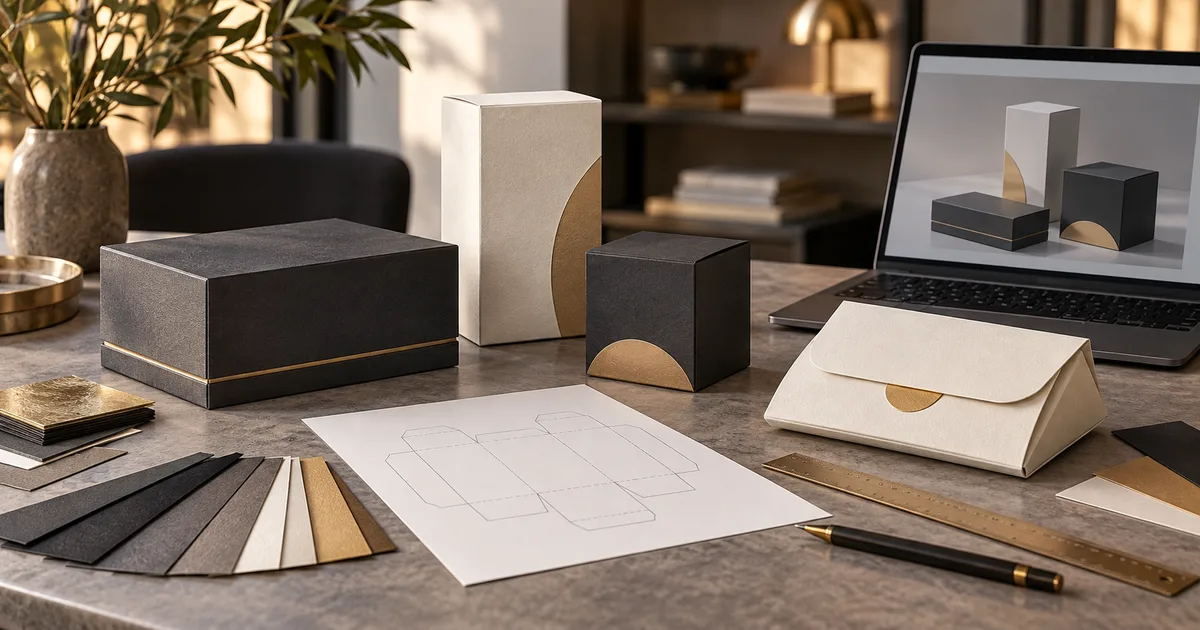
Low MOQ Custom Packaging for Small Brands: How to Compare Suppliers, Samples, and Landed Cost
Small brands often want packaging that feels intentional before they can commit to a large production run. The problem is that the market can force an uncomfortable choice: buy a small quantity of plain stock packaging, or order thousands of branded units before the product, artwork and demand have been properly tested. Between those two extremes, founders and designers are looking for a supplier that can provide a credible prototype, a sensible first quantity, transparent pricing and a repeatable route to the next order.
Recent conversations among packaging buyers describe the same frustrations: minimums that change by structure, unclear setup fees, rush charges that appear late, samples that do not match the production order, slow proofing and a lack of useful mockups. The answer is not simply to find the lowest minimum order quantity. A low MOQ is valuable only when the sample, landed cost, quality controls and reorder process are also clear.
Executive answer
To compare low MOQ custom packaging suppliers, request the same brief from each supplier and score five things separately: prototype quality, total landed cost, production timeline, repeat-order control and communication. Ask for a physical sample or production-intent proof before committing to a larger run. Make every fee visible, including tooling, setup, artwork checking, sampling, packing and freight. A supplier that can start with a sensible test quantity and preserve the approved specification is usually a better long-term choice than the supplier with the lowest headline unit price.
1. Define what “low MOQ” means for your project
There is no universal low MOQ. Thirty printed mailers, 250 rigid boxes and 1,000 premium gift sets can all be described as low quantity in different supply chains. The practical question is how the quantity interacts with the chosen structure and the supplier’s production method. Digital print may support a small run but have a different colour or surface result. Offset printing and special finishing can become more economical at a higher quantity. A rigid box with hand assembly may have a different minimum from a folding carton that runs on an automated line.
Write three quantities into your brief: the prototype quantity, the first sellable batch and the expected reorder band. For example, a brand may need one or two structural samples, 250 units for a launch test and 1,000 to 3,000 units if the product validates. This gives the supplier a reason to recommend a structure that can scale rather than pricing a one-off object that is difficult to repeat.
2. Separate prototype, sample and sellable production
A prototype is used to test the construction. It may be blank, digitally printed or made with substitute materials. A decorated sample checks the visual system: paper, colour, foil, coating, logo placement and texture. A production-intent sample uses the board, wrap, insert and finishing process intended for the first sellable batch. These stages are not interchangeable.
If your product is fragile, heavy or dimensionally sensitive, request a physical sample with the real product or a load substitute. A 3D rendering can help evaluate the shape, but it cannot prove running clearance, insert pressure, closure force, edge quality or the way a coating feels. Use the render to shorten decisions and the physical sample to approve risk.
Ask the supplier to label each sample with a version, date and specification. Keep the approved sample or a controlled set of photographs with your purchase order. When the order is repeated, the supplier should be able to say which board, paper, insert, finish and dimensions were used.
3. Use a common brief when comparing suppliers
A supplier comparison becomes unreliable when each company receives a different description. Send the same one-page request to every candidate. Include the product dimensions, weight, opening path, box style, artwork coverage, material preference, finish, insert, quantity bands, destination and required arrival date. Add a simple product drawing or photograph, but do not rely on a photograph as the specification.
For a small brand, the brief should also explain what is flexible. Perhaps the outer size can change by a few millimetres, the insert can use a standard paperboard construction, or the first run can use one colour instead of a complex foil. Flexibility helps a supplier design a lower-risk path without weakening the brand experience.
| Brief item | Example question | Why it affects the quote |
|---|---|---|
| Structure | Folding carton, rigid setup, drawer, mailer or collapsible box? | Changes tooling, assembly and packed volume |
| Product load | What is the product size, weight and fragile contact area? | Determines board, clearance and insert strength |
| Artwork | One side, wraparound, inside print, foil or multiple SKUs? | Changes print passes and approval work |
| Quantity | Prototype, first batch and annual reorder band? | Shows whether the solution can scale |
| Destination | Which country, postcode, warehouse or fulfilment centre? | Enables realistic freight and carton planning |
| Timing | When must the finished packs arrive? | Exposes sampling, production and transit risk |
4. Calculate landed cost instead of comparing unit price
Small orders can make a low unit price look attractive while the total project cost becomes surprisingly high. Build a landed-cost view that includes the product, sampling, tooling, artwork or prepress, setup, packing, freight, insurance, duties where applicable and any fulfilment labour. If a supplier quotes a delivered price, ask which delivery term and destination assumptions are included.
Also calculate the cost of learning. A sample fee may be worthwhile if it prevents a mis-sized insert or a colour failure in the sellable batch. A slightly more expensive supplier may be less expensive overall if the proof is accurate, the packaging arrives in a usable condition and the reorder file is controlled.
| Cost block | What to confirm | Common surprise |
|---|---|---|
| Sample | Blank, printed or production-intent? | A low sample price may use substitute materials |
| Tooling | Die, mould, cutting file or insert tool? | A setup charge appears only after artwork approval |
| Printing | Process, colour count and proof type? | Digital proof does not match offset production |
| Finishing | Foil, emboss, coating, window or ribbon? | Finish is priced per setup or per SKU |
| Assembly | Folding, gluing, magnets, insert loading? | Manual labour is excluded from the headline price |
| Freight | Carton count, packed volume and delivery term? | Assembled boxes cost more to store and ship |
5. Look for the hidden-fee pattern
A supplier does not become untrustworthy because it charges for sampling or tooling. Those are real production activities. The risk appears when the fee is not explained until the buyer has already invested time or approved artwork. Ask for an all-in estimate before the sample is started and request a list of conditions that would change it.
The most useful question is: “What is not included in this price?” Ask about artwork checking, dieline changes, colour correction, rush production, split shipments, small-quantity handling, individual packing and storage. Ask whether a second sample is included if the first sample misses an agreed specification. Transparency at this stage is more valuable than a discount that cannot be audited.
6. Treat mockups and proofs as a quality-control tool
A useful mockup is not only a sales image. It should expose how the artwork wraps around a corner, where the logo sits relative to a fold, how an insert supports the product and whether a label or variable panel is in the right place. Request a dieline, a flat artwork proof and a three-dimensional view when the structure is complex.
For small brands, good proofing also reduces back-and-forth. Ask the supplier to mark the cut line, safe area, bleed, fold direction, magnet or adhesive location and any areas that cannot carry foil or fine text. Approve these details before printing. If the supplier does not offer a clear proofing workflow, create your own sign-off sheet so that the decision is still documented.
7. Make sample-to-production consistency a scored requirement
One of the most damaging packaging surprises is receiving a production order that looks different from the approved sample. The cause may be a paper substitution, a different coating, a colour-management gap, a change in insert material or a production line that uses a different finishing method. The remedy is to name the approved sample and the acceptance criteria in the order file.
Check the real sample for dimensions, squareness, edge wrapping, colour, surface texture, glue marks, insert fit, closure force and visible hardware. Decide which variations are acceptable and which require rework. If a supplier cannot describe its inspection process, ask for a sample inspection record or a set of photographs taken before shipment.
For repeat orders, ask how the supplier stores the artwork, material specification, finishing recipe and approval reference. A reordering process should not depend on one person remembering the last conversation.
8. Compare lead time as a sequence, not a single number
“Two weeks” can mean two weeks of printing after artwork approval, not two weeks until the packaging is in your warehouse. Ask the supplier to split the schedule into brief review, dieline, blank sample, decorated sample, approval, production, inspection, packing and transit. If the order is shipped internationally, include the delivery term and the point at which the supplier considers the order complete.
A small test batch often benefits from a standard structure, a single SKU and a simple finish. If the brand needs custom dimensions, a special insert, multiple languages and several finishes, the schedule will grow even when the quantity is small. Good suppliers explain the trade-off rather than promising an unrealistic date.
9. Choose the structure that supports the next order
The cheapest first run can create a costly second run if the structure cannot be repeated. When selecting a format, ask whether the same outer box can support several product sizes, whether the insert can change without replacing the entire tooling set, and whether the artwork can be updated without rebuilding the construction. A modular rigid box, a standard mailer with a custom insert or a controlled paperboard carton can give a small brand more flexibility than a complex one-off shape.
For premium presentation, a small order may be better served by a compact rigid box, a drawer box or a collapsible rigid structure than by a heavily decorated low-cost carton. For shipping-first products, a custom corrugated mailer may be more efficient. The right choice is the one that balances product protection, brand signal, packed volume and reorder economics.
10. Supplier due diligence for a first order
Before paying a deposit, verify who is responsible for the project and where production occurs. Ask for the legal trading name, factory or converting location, sample address, quality contact and escalation route. Look for evidence that the supplier has handled a similar board, finish, insert or product load. A portfolio proves that an image exists; it does not prove that the supplier can repeat the result for your specification.
Ask how the supplier handles a material shortage, a failed sample, a colour deviation or a missed ship date. Ask whether the supplier can provide inspection images and packed carton data before dispatch. A direct answer with clear limits is a positive signal. A vague answer followed by pressure to pay quickly is a reason to slow down.
11. A scorecard for small-brand packaging suppliers
Score each supplier from 0 to 5 across six categories: sample accuracy, price transparency, MOQ flexibility, timeline clarity, quality evidence and reorder control. Weight sample accuracy and price transparency more heavily than a polished website. Add a seventh category for communication: can the supplier answer a technical question without turning it into a generic sales pitch?
Do not award a high score for a low MOQ alone. A supplier offering 25 units may still be a poor fit if the packaging cannot be repeated, the sample is not representative or the freight makes the order uneconomic. Conversely, a supplier that starts at 250 units may be the better choice if it provides a reliable sample, clear landed cost and a repeatable standard.
12. A practical launch path
For a first launch, use a four-step path. Step one is a controlled brief with one primary structure and one quantity band. Step two is a blank or digital prototype to confirm dimensions and fit. Step three is a decorated production-intent sample with the actual paper, board, insert and finish. Step four is a small sellable batch followed by a reorder review that records what should stay fixed and what can improve.
This path keeps the first decision manageable while creating evidence for the next order. It also gives the brand content it can use internally: the approved sample, material file, product photographs, packed dimensions and a clear supplier record.
13. Questions to send with your enquiry
Use these questions to make supplier answers comparable: What is the recommended structure for this product load? What quantity bands can you support? Which fees are one-time and which repeat? What will the physical sample use? Can you show a dieline and 3D mockup before printing? What is the complete timeline to my delivery point? How do you inspect colour, fit and finish? What happens if a material changes? How is the approved standard stored for reorders?
A supplier who can answer these questions clearly is already reducing risk. If the answer is “we can discuss later,” keep the question open until it is written into the quote or approval record.
Conclusion
Low MOQ custom packaging is not a race to the smallest number. It is a way for a small brand to buy learning, test demand and build a repeatable physical identity without overcommitting cash. Compare suppliers by the quality of the sample, the honesty of the landed-cost model, the clarity of the timeline and the discipline of the reorder process.
luxupackage supports small and growing brands with custom rigid boxes, paper-based inserts, mailers, gift sets and retail packaging. Share the product dimensions, quantity band, destination and launch date to receive a structure recommendation and a comparable quotation path.
FAQ: Low MOQ Custom Packaging for Small Brands
What is a realistic low MOQ for custom packaging?
It depends on the structure and production method. A digital-printed mailer may support a very small run, while a premium rigid box often needs a higher minimum because of board conversion, finishing and manual assembly. Ask for prototype, first-batch and reorder quantities separately.
How can I avoid hidden fees from a packaging supplier?
Request an all-in estimate and ask what is excluded. Confirm tooling, setup, artwork checking, sample revisions, finishing, assembly, packing, freight, rush work and split shipments before approving the project.
Is a 3D mockup enough to approve custom packaging?
No. A 3D mockup is useful for artwork and structure decisions, but a physical sample is needed to check fit, board stiffness, surface feel, colour, closure force, insert pressure and production quality.
How do I compare two suppliers with different MOQs?
Compare the complete landed cost and the risk of the first batch, not only the unit price. Include sampling, tooling, freight, storage, fulfilment labour and the cost of replacing packaging that does not match the approved standard.
What should be saved for an easy reorder?
Keep the approved sample reference, dieline, artwork, board and paper description, finish, insert dimensions, tolerances, packing method, inspection criteria and the supplier contact responsible for the account.
