How to Choose a Rigid Paper Packaging Supplier in the UK: A Practical 2027 Buyer Checklist
Turn the guidance into a production brief
Send your product size, quantity, destination and target date for a structured packaging recommendation and quote.
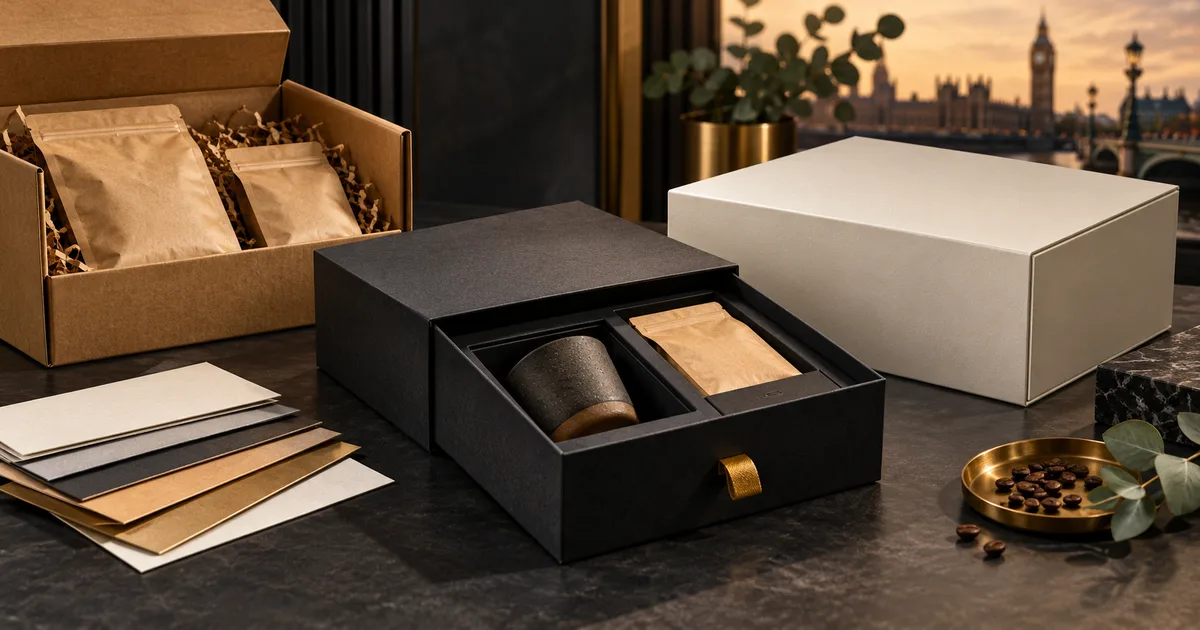
How to Choose a Rigid Paper Packaging Supplier in the UK: A Practical 2027 Buyer Checklist
When a brand team asks for a rigid paper packaging supplier in the UK, the request is rarely only about finding a box. The team is usually trying to solve several connected problems at the same time: the package must look credible in a premium retail setting, protect the product through fulfilment, fit an evolving product range, arrive at a predictable landed cost and leave a clear material record for future compliance conversations. A supplier that can only show a beautiful finished photograph has not answered the full procurement question.
Recent practitioner discussions in packaging communities repeatedly return to the same questions: which supplier is dependable, how should a bespoke paper container be specified, what is the difference between a retail presentation box and a shipping pack, and how can a buyer compare two quotations when the line items are not described in the same way? This guide turns those questions into a practical decision process for UK and European buyers.
Executive answer
The best supplier is the one that can convert your product brief into a controlled specification, prove the specification with physical samples, document the material and finishing system, and explain how the packed order will move from factory to your delivery point. Start with the product load and channel, not with a catalogue photograph. Request the same information from every supplier, compare assembled and flat-pack options using packed volume, and keep an approved reference sample with your purchase order.
1. Start with the use case, not the phrase “luxury box”
“Luxury” can describe a rigid magnetic box, a paperboard carton, a drawer presentation box, a coffee gift set or a reusable paper container. These structures behave differently in production and in distribution. Before contacting suppliers, write a one-page brief that answers six questions: what is inside, how heavy is it, how is it removed, where will it be opened, how will it be shipped and how many units are needed in the first run?
A fragrance bottle may need a fitted insert and a clean neck clearance. A coffee gift set may need dividers, an information card and enough tolerance for several pouch sizes. A jewellery box may need a soft contact surface and an anti-tarnish material decision. A retail carrier may need a reinforced handle and a bottom construction that survives repeated handoff. The outer paper can be similar while the engineering brief is completely different.
Use the following short brief before asking for a quote:
| Brief field | What to record | Why it matters |
|---|---|---|
| Product load | Product dimensions, weight, fragile faces and accessories | Determines board, insert and clearance decisions |
| Opening path | Lid, drawer, magnetic flap, collapsible or carrier bag | Defines the consumer and fulfilment experience |
| Sales channel | Retail, gifting, subscription, e-commerce or event | Changes handling and protection requirements |
| Quantity | Pilot, first production and expected reorder volume | Enables a fair MOQ and unit-cost comparison |
| Delivery point | UK postcode, EU warehouse or third-party fulfilment centre | Allows packed volume and freight to be modelled |
| Documentation | Material, fibre, coating, adhesive and inspection records | Creates a traceable file for internal and external review |
2. Know which rigid paper structure you are actually comparing
A rigid setup box is built around a wrapped board core and normally arrives assembled. It gives a substantial hand feel and strong shelf presentation, but the assembled volume can be expensive to store and transport. A collapsible rigid box uses engineered folds or joints so that the same visual language can travel flat. It can reduce packed volume, yet it introduces a different tolerance and assembly conversation. A drawer box adds a moving component and must be checked for running clearance, pull force and insert alignment.
For a coffee or tea programme, a paperboard folding carton may be the efficient answer when the product is already protected in an inner pouch. For a premium gift set, a rigid box with a paper-based insert can create a more deliberate opening sequence. Do not ask a supplier to price “a rigid box” without stating whether the order is assembled, collapsible, drawer-style or intended to carry a separate inner pack.
The supplier should be able to provide a structure drawing or dieline before final artwork. That drawing should identify board thickness, wrap allowance, fold or V-groove positions, magnet or hardware locations, insert clearance, glue areas and the packed condition. A clean drawing is often more useful than another lifestyle image because it exposes what is really being purchased.
3. Build a material specification that can be checked
Paper packaging discussions often use attractive but incomplete phrases such as “eco paper,” “premium board” or “recyclable box.” A procurement file needs the actual material system. Ask for the board type and grammage, the outer paper, the coating or lamination, the adhesive, the insert material and any non-paper components. If a magnet, ribbon, foil, window film or plastic fitting is present, record it separately rather than describing the entire pack as one material.
For fibre claims, ask which part of the pack is covered by a certificate or declaration and which parts are not. A certificate is useful only when its scope matches the material and production route being purchased. For a UK or European launch, the buyer should also request the supplier’s current information about fibre composition, coatings, inks and separation at end of life. This does not replace local regulatory advice; it gives the compliance or sustainability team a usable starting file.
For paper-based inserts, compare protection rather than appearance alone. Folded paperboard, corrugated board, honeycomb, moulded fibre and wrapped board can all be appropriate, but the best choice depends on product mass, drop orientation, contact points and removal force. A beautiful insert that lets a bottle move during parcel handling is a failed specification.
4. Treat PackUK and RAM questions as a data-readiness exercise
Packaging teams watching UK obligations such as PackUK and packaging extended producer responsibility updates are asking a sensible operational question: can the supplier give us the information we will need later? The correct response is not to promise that one box is automatically compliant. Instead, create a data pack that identifies the material, weight, component breakdown, destination, supplier identity and evidence available for the order.
Ask the supplier to distinguish between a design statement and a verified record. “Paper-based” is a design statement. A dated material specification with grammage and component weights is a record. “Recyclable” is a broad claim. A documented construction that identifies the paper, coating, adhesive and removable hardware is more useful to a reviewer.
A practical RAM-readiness checklist includes: a component-level bill of materials; approximate weight by component; fibre or recycled-content declarations where applicable; coating and adhesive descriptions; artwork and finish approvals; production-site identity; inspection records; packed-carton dimensions; and a process for updating the file when a component changes. Confirm the latest reporting requirements with your UK compliance adviser before making a legal claim or filing a return.
5. Compare suppliers with the same commercial question
The most common quotation mistake is sending one supplier a detailed brief and another supplier a single reference photograph. The resulting prices are not comparable. Use a common request-for-quote sheet with the same dimensions, quantity, artwork coverage, finish, insert, assembly condition, destination and required arrival date. Ask each supplier to separate tooling, sampling, setup, unit, packing and freight costs.
A low unit price may hide assembled shipping volume, manual insert work or a finish that is not included in the first sample. A higher quote may include a stronger board, a better packed configuration or an inspection step that reduces rework. Compare the complete landed outcome, not a single number.
| Quotation line | Question to ask | |
|---|---|---|
| Tooling | Is the die, mould or cutting setup a one-time charge, and who owns the approved file? | |
| Sampling | Does the sample include the actual board, paper, finish, insert and closure? | |
| Unit cost | Which quantity band and which production tolerance does this price assume? | |
| Assembly | Are folding, gluing, magnet insertion, ribbon tying and insert loading included? | |
| Packing | How many units per export carton, and what are the outer dimensions and gross weight? | |
| Freight | Which delivery term, route, insurance and customs responsibilities are included? | |
| Reorders | What remains fixed, what can change, and how is the approved standard referenced? |
6. Make the sample process do the risk reduction
A professional sample process is not a single photo approval. For a new structure, use at least three checkpoints when the programme is commercially important. First, approve a blank structural sample to check dimensions, movement, fit and opening behaviour. Second, approve a decorated production-intent sample to check colour, foil, print registration, coating, texture and logo position. Third, approve a packed sample or transit check when the package will travel through parcel, pallet or long-distance freight networks.
Record the sample version, date, material, dimensions, colour reference, insert fit, closure behaviour and open issues. The approved sample should be identifiable in the purchase order and quality plan. If a supplier changes the paper, adhesive, insert or finish because of availability, require a written change notice and a new approval decision.
For a rigid paper container, inspect the corners, wrapped-paper joints, lid alignment, drawer running clearance, magnet seating and visible glue. For a coffee gift box, inspect whether pouches or tins can be inserted quickly without tearing an edge or crushing a divider. For a retail bag, inspect handle anchoring, top-fold reinforcement and the base under load. These are small checks that prevent large rework costs.
7. Ask how the supplier handles brand consistency
Many brands do not need one box; they need a family of boxes that looks related across sizes, seasons and product launches. Ask how the supplier controls colour across different substrates, whether Pantone references are checked on the actual outer paper, and how repeat orders are matched to the approved standard. A colour proof on one paper cannot automatically guarantee the same result on another coated or textured stock.
For a modular gift set, define the common outer architecture first and allow the insert to change by SKU. That approach can reduce artwork and tooling duplication while preserving a consistent shelf presence. For a coffee programme, reserve a quiet area for variable roast, origin or flavour information rather than changing the entire box every time. A supplier that understands controlled variation is more useful than one that only sells isolated custom pieces.
8. Plan the UK or European delivery path before production
The delivery plan should begin while the structure is being designed. Request assembled and flat-pack dimensions, carton count, gross weight, pallet pattern and expected production window. A collapsible box may save storage and freight volume, but it can require an assembly instruction or additional fulfilment labour. A rigid setup box may be faster at the packing station but consume more warehouse space.
Ask who is responsible for export packing, carton labels, moisture protection, inspection photos and shipment traceability. Give the supplier the actual delivery postcode or warehouse constraints so a freight option can be evaluated against reality. A quote that says “shipping included” without a delivery term or packed dimensions is not a complete logistics proposal.
For seasonal launches, work backwards from the date the finished packs must be available in the UK. Include artwork approval, structural sampling, decorated sampling, production, inspection, export packing, transit and a contingency window. If the supplier cannot explain the critical path, the risk has not disappeared; it has simply moved into the calendar.
9. Supplier due diligence: what to verify before the deposit
A polished website is not a factory audit. Before placing a first order, request the legal trading name, production location, contact person, sample address, quality contact and the documents relevant to your product. Ask for recent examples of similar structures, but also ask what the supplier does when a material is unavailable, an insert fails a fit check or a colour falls outside the agreed reference. The response reveals more than a portfolio page.
Useful evidence includes a controlled specification, physical sample photos with a scale reference, inspection records, material declarations, carton and shipment records, and a clear escalation path. If a supplier refuses to identify the construction or cannot explain how a repeat order is matched, treat that as a procurement risk. If the supplier is willing to describe limits, tolerances and approval gates, the conversation is more likely to become dependable.
10. A simple decision scorecard
Score each supplier from 0 to 5 against the same headings: structure fit, material transparency, sample discipline, colour and finish control, packed logistics, evidence quality, communication speed and reorder control. Weight structure fit and sample discipline more heavily than portfolio aesthetics. A supplier with a lower visual score but strong documentation may be the better choice for a regulated or repeat programme.
Do not use the scorecard as a substitute for a physical sample. Use it to decide which suppliers deserve the next checkpoint. Once the sample arrives, update the score with evidence from the real object: fit, movement, finish, odour, edge quality, closure force, packing protection and ease of assembly.
11. The specification to send to a rigid paper packaging supplier
A useful enquiry can fit on one page when it is structured. Include the product dimensions and weight, the desired outer dimensions, the structure, the opening path, the insert, the material and finish, the artwork coverage, the initial quantity, the expected annual volume, the delivery country and the target arrival date. Add photographs or a simple product drawing only as supporting information; never make the photograph the specification.
End with the decisions you want the supplier to return: recommended board and wrap, assembled versus collapsible comparison, sample stages, MOQ, quantity bands, tooling, lead time, packed carton data, delivery term, inspection method and the evidence available for the material file. This format makes it easier to compare answers and easier for a supplier to flag a conflict before producing a sample.
12. Final recommendation
If you are sourcing rigid paper packaging in the UK or Europe, choose the supplier that makes the unknowns visible. A good partner will talk about the product load, structure, material system, sample checkpoints, packed volume, documentation and repeat-order control in the same conversation. That is the difference between buying a beautiful object and building a packaging programme.
luxupackage helps brand teams turn this type of brief into a controlled quote, sample and production path for rigid boxes, paper-based inserts, coffee and tea gift sets, fragrance packaging, jewellery boxes and retail paper bags. Share the product dimensions, quantity, destination and target date to start a comparable recommendation.
FAQ: Rigid Paper Packaging Supplier Questions
What should I send to a UK rigid paper packaging supplier for an accurate quote?
Send product dimensions and weight, box structure, quantity, artwork coverage, finish, insert requirements, delivery postcode and required arrival date. Ask the supplier to separate tooling, sampling, unit, packing and freight costs.
Is a collapsible rigid box always cheaper than an assembled rigid box?
No. A collapsible box can reduce packed volume and storage cost, but it may add engineering, assembly or handling requirements. Compare the full landed and fulfilment cost rather than only the unit price.
How can a supplier support PackUK or RAM-related packaging data requests?
Ask for a component-level material description, approximate component weights, fibre or recycled-content information where available, coating and adhesive details, supplier identity and order-specific records. Confirm current reporting duties with a qualified UK compliance adviser.
How many samples should I approve before mass production?
For a new or high-risk structure, approve a blank structural sample, a decorated production-intent sample and a packed or transit sample when distribution protection matters. Record the approved version and link it to the purchase order.
What is the most important supplier warning sign?
A supplier that gives a price without a clear construction, material breakdown, packed condition, sample plan or change-control process creates avoidable risk. Ask for the missing detail before comparing the quote.
